What is an Agent Runtime?
An agent runtime is the infrastructure layer responsible for executing and managing AI agents in production. Depending on its scope, it can provide durable execution, orchestration, state and concurrency management, operational control, and secure hosting or sandbox isolation.
Key takeaways
- An agent framework helps you build an agent, a harness runs its agent loop, and a runtime helps you run and manage it in production.
- A runtime coordinates the agent's execution and the infrastructure around it, not just its model and tool loop.
- Durable execution is especially important for agents that run for a long time, call unreliable tools, wait for people, or cause external side effects.
- Runtime state covers what an agent needs within an execution and across turns, including progress, message history, preferences, and application data.
Agent framework vs. agent harness vs. agent runtime
Agent frameworks, harnesses, and runtimes are complementary layers, although the boundaries are not standardized and products may combine them.
| Agent framework or SDK | Agent harness | Agent runtime | |
|---|---|---|---|
| Primary job | Provide building blocks for defining an agent's behavior | Provide and run the agent's orchestration loop | Execute and manage the running agent in production |
| Typical responsibilities | Model and tool APIs, prompts, handoffs, and agent-building abstractions | Loop control, prompt and tool wiring, context management, memory policy, and execution limits | Lifecycle, recovery, durable state, concurrency, security, scaling, observability, and control |
| Examples | OpenAI Agents SDK, Vercel AI SDK, Google ADK, and Pydantic AI | Custom agent loops and Amazon Bedrock AgentCore harness | Restate, Amazon Bedrock AgentCore Runtime, Cloudflare Agents, Temporal, and LangGraph Runtime |
| Relationship | Used to build agent logic or a harness | Uses a framework or custom code and runs on a runtime | Executes harnesses, framework-based agents, or custom agent code |
A framework provides the building blocks for defining an agent. A harness governs how the agent reasons and acts, while a runtime keeps that execution reliable and manageable across failures, long waits, concurrent work, and distributed services.
Why do AI agents need a runtime?
An agent may call an LLM several times, invoke tools, update databases, delegate to other agents, wait for human approval, and stream progress to a client. These steps can cross processes and services and take seconds, hours, or days.
That makes an agent a distributed application: providers rate-limit requests, tools time out, clients disconnect, processes crash, and requests race to update the same session. Retrying from the beginning can repeat costly model calls or real-world actions. A runtime moves the machinery for tracking, recovery, coordination, and control out of the agent's business logic.
What does an agent runtime do?
Execute agents and manage their lifecycle
The runtime starts an agent, tracks whether it is running, waiting, completed, or failed, and returns or streams its output. Long-running agents may receive an execution ID that clients can reconnect to or query later. Some runtimes primarily provide managed hosting: Amazon Bedrock AgentCore Runtime, for example, hosts and scales agent code while leaving the orchestration loop to the developer.
Recover from failures with durable execution
Durable execution records the progress of a running program so it can resume from a recorded point after a crash or restart. For an agent, the recorded steps can include model responses, tool results, routing decisions, timers, and human approvals. The exact recovery boundary depends on the runtime and how side-effecting operations are wrapped; external actions may still need idempotency protection.
This is more than keeping conversation history: the runtime must know which operations completed, which can be retried safely, and where to continue. Google's Agent Executor describes durable execution and resumption as runtime responsibilities. The OpenAI Agents SDK likewise documents durable execution integrations for runs spanning failures, restarts, or long waits.
Manage state and memory
State includes execution progress and intermediate results as well as multi-turn data such as context, message history, user preferences, and application-specific values. A runtime associates that state with stable execution, session, user, or agent IDs.
For conversation history, a runtime may store raw messages directly or integrate with a memory system, like mem0, Zep, or Letta, that retrieves or summarizes the most relevant information for the current turn.
Coordinate concurrency and parallelism
A runtime coordinates concurrent access to agent state and resources. It can serialize requests that update the same session to prevent races while allowing independent sessions, agents, or tool calls to run in parallel. Concurrency and rate limits prevent bursts of agent work from overwhelming model providers, tool APIs, downstream services, or other shared infrastructure.
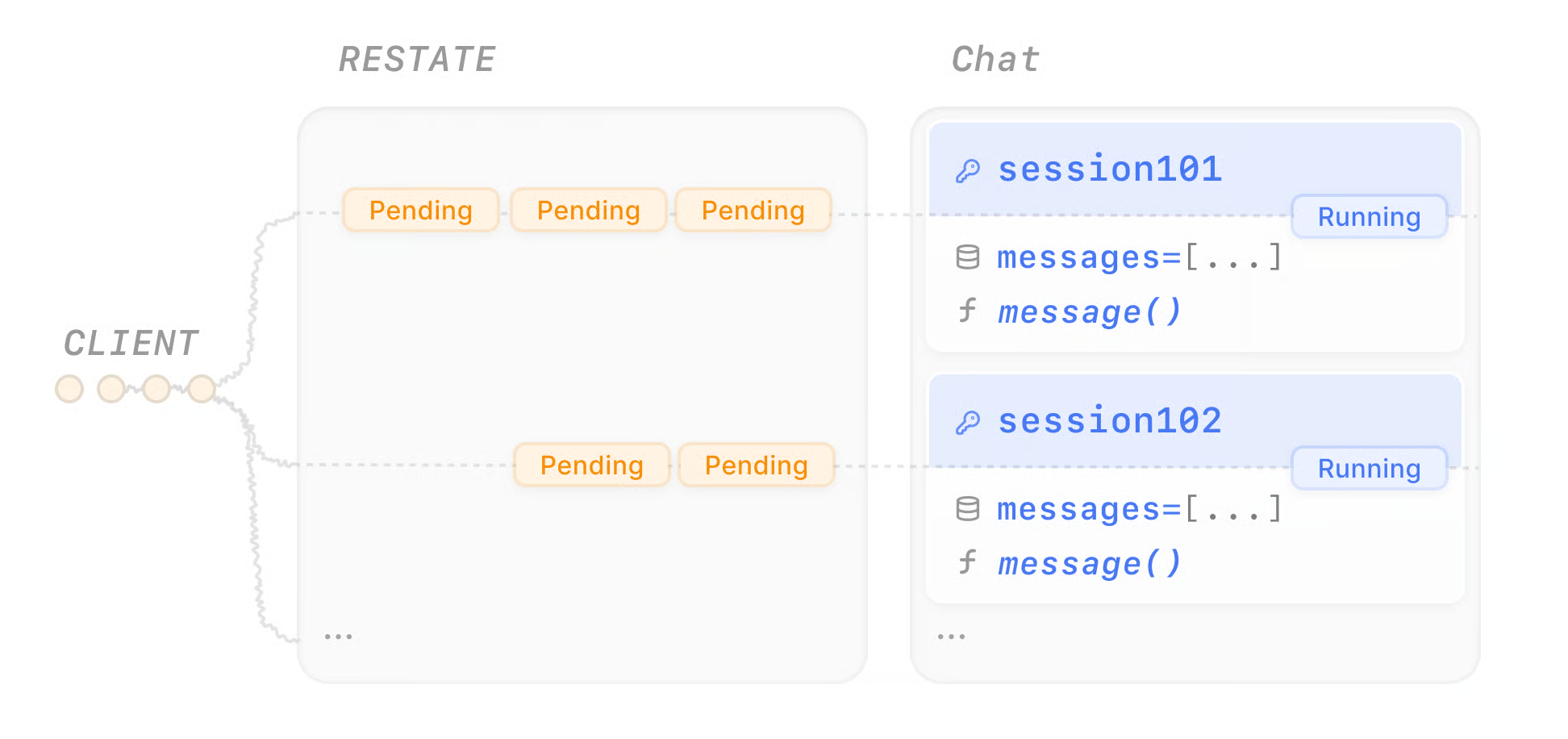
Restate's Virtual Objects are stateful entities with single-writer guarantees to prevent concurrent requests from overwriting the same agent state.
Orchestrate tools, agents, and human input
Agent orchestration coordinates model calls, tools, subagents, deterministic workflows, and people. A runtime can support parallel agents and tool calls, fan-out and fan-in, agent handoffs, scheduled work, and human approval. It can suspend an agent while it waits for a webhook, another agent, or a person, then resume the correct execution without holding compute.
For multi-agent systems, reliable request-response calls, asynchronous messages, queues, and concurrency limits let agents communicate across processes without implementing their own delivery and recovery logic.
Provide observability and operational control
Agent observability explains which model and tools were called, how state changed, where an execution is waiting, and why it failed. Operational control lets teams cancel a stale run, kill a runaway agent, pause work during an outage, resume it later, or restart from an earlier point. Cloudflare similarly describes its Agents runtime in terms of state, communication, execution, and operations.
Runtime observability records and controls execution; evaluation tools separately assess the quality, safety, or correctness of agent behavior.
Host and scale agent code
Managed runtimes may deploy agent code, isolate sessions, and scale compute. Others provide execution guarantees while agent code runs on containers, Kubernetes, serverless functions, or another platform.
Secure and isolate agent execution
Runtime security can include caller authentication, access control, tenant isolation, encrypted data, and managed credentials. These controls protect access to the runtime and its data; a sandbox separately limits what agent or tool code can access while it executes.
Some runtimes provide isolated sandboxes for code, shell commands, browsers, or other potentially untrusted tools; others integrate with services such as Cloudflare Sandbox, E2B, Modal Sandboxes, or Daytona. A sandbox supplies an isolated filesystem, processes, and compute, in which an agent can operate with carefully managed credentials.
Technologies used as agent runtimes
These technologies cover different runtime responsibilities and are not all direct substitutes:
- Restate is an open-source durable runtime spanning agents, services, and workflows, with durable execution, state, communication, flow control, observability, and operational control.
- Temporal is a durable workflow platform that can be used to build long-running agents with recovery, retries, task queues, timers, and signals.
- LangGraph Runtime is an orchestration runtime for graph-based agents, with checkpoint-based persistence, streaming, and human-in-the-loop execution. Agent Server and LangSmith Deployment add production lifecycle and hosting capabilities.
- Cloudflare Agents is a stateful runtime on Durable Objects, covering state, communication, scheduling, and recovery.
- Amazon Bedrock AgentCore Runtime provides managed serverless hosting, scaling, and isolated sessions for framework-based or custom agents.
- Google Cloud Agent Runtime provides managed hosting and scaling for ADK, several open-source frameworks, and custom Python agents.
- Google Agent Executor is an open-source distributed runtime standard for durable execution, secure isolation, session consistency, and connection recovery.
Comparison of selected runtime approaches
The table compares three technologies commonly used to run production agents. Their scopes differ: Restate and Temporal provide general durable execution for distributed applications, while LangGraph and its deployment stack center on agent orchestration.
| Aspect | Restate | Temporal | LangGraph with Agent Server / LangSmith Deployment |
|---|---|---|---|
| Distribution and hosting | OSS self-hosted; Restate Cloud; managed BYOC. Agent code runs on your compute. | OSS self-hosted; Temporal Cloud. Workers run separately. | OSS LangGraph library; Agent Server can be self-hosted or deployed through LangSmith Cloud or a self-hosted LangSmith platform. |
| Agent SDKs and custom logic | Agent SDK integrations or a custom loop. | Agent SDK integrations or custom workflow code. | LangGraph agents, plus other frameworks wrapped through its Functional API for deployment. |
| Lifecycle management | Durable invocation IDs and status tracking; clients can submit work asynchronously, attach to running executions, or retrieve results later. | Workflow IDs and status tracking; clients can start, query, signal, or wait for Workflow Executions. | Runs are tracked within threads; clients can stream, inspect, cancel, or rejoin runs on supported deployments. |
| Durable execution | Fine-grained step journaling and automatic recovery. Steps can be inline or remote calls. | Workflow history and replay; Activities run side effects as separately retried remote tasks on workers. | Graph-state checkpoints at super-step boundaries, with node writes persisted for fault tolerance. Side effects need explicit task boundaries and idempotency protection. |
| State and memory | Keyed, long-lived K/V state through Virtual Objects, with single-writer consistency per key. | Workflow-local state recovered from history; shared application state is typically external. | Thread checkpoints and cross-thread Stores provide persistent state and memory. |
| Concurrency and parallelism | Parallel durable steps and service calls; per-key serialization; scope-based hierarchical concurrency limits. | Activities and child workflows can run in parallel; task queues and worker controls bound throughput. | Graph scheduling supports parallel branches; deployment worker and job settings bound throughput. |
| Communication and orchestration | Durable RPC, asynchronous messages, and queues across services. | Task queues, Signals, Updates, and Nexus calls. | Channels, edges, and subgraphs inside a graph; no general service-messaging layer. |
| Observability and control | UI and SQL access for journal and state inspection, OpenTelemetry, cancel, kill, pause, resume, and restart. | UI for event histories and metrics; cancel, terminate, signal, and reset. | LangSmith tracing and Studio; interrupts and checkpoint-based time travel. |
| Hosting and sandboxes | Agent code runs on your compute; use that compute environment or an external sandbox for agent and tool isolation. | Workers run on your compute; agent and tool isolation comes from that environment or an external sandbox. | Agent Server has self-hosted and managed deployment options. LangSmith Sandboxes; external sandboxes can also be integrated. |
Sources reviewed July 31, 2026: Restate AI documentation, Temporal Workflow Executions, LangGraph persistence, LangSmith Deployment, and LangSmith Sandboxes.
The right choice depends on which responsibilities you need from one product. A managed hosting runtime may be enough for session isolation and scaling. An agent that performs consequential, long-running work may also need durable execution, reliable communication, coordinated state, and operational controls.
Do all agents need an agent runtime?
Not necessarily. A short-lived agent that performs one model call, uses no shared state, and can safely restart from the beginning may run as an ordinary application process.
A dedicated runtime becomes useful when an agent:
- runs for hours, days, or weeks;
- supports multi-turn conversations;
- performs costly model calls or tools with side effects;
- must recover from failures without losing progress;
- coordinates hundreds or thousands of concurrent sessions;
- waits for human approval, webhooks, or scheduled events;
- communicates with other agents and services;
- needs to be inspected, cancelled, paused, resumed, or restarted; or
- must scale across processes, containers, or serverless functions.
How does Restate work as an agent runtime?
Restate is an open-source durable execution runtime for agents and distributed applications. It sits beneath, rather than replacing, an agent framework or harness and makes model calls, tool executions, service calls, state changes, timers, and routing decisions recoverable when they run as durable steps.
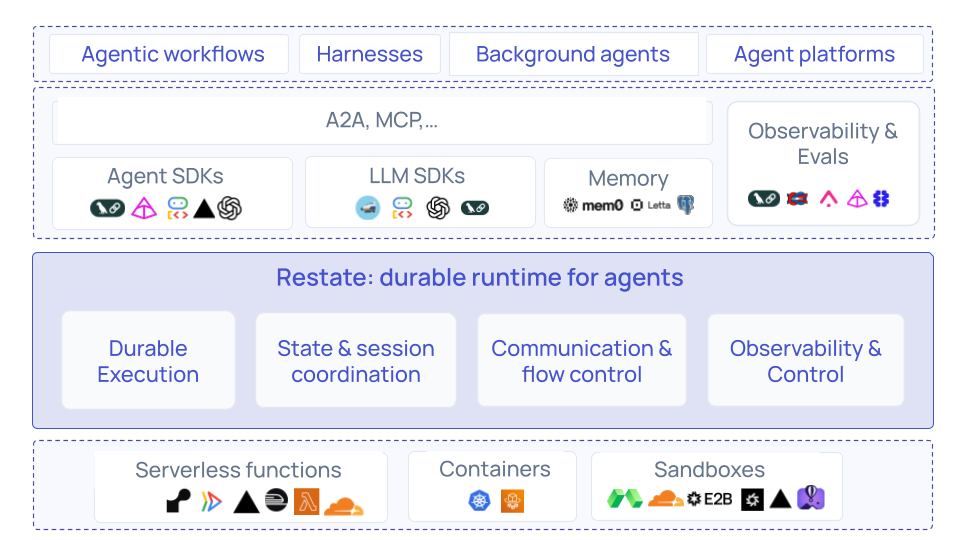
Restate provides the durable execution layer beneath an agent framework or harness while agent code, models, tools, sandboxes, and backend services remain independently deployable.
Restate records completed durable steps and their results in a journal. After a crash or restart, it replays the execution, skips journaled work that already completed, and continues from where it left off without repeating those model calls or external side effects.
The same runtime coordinates state and communication across the agentic application. Virtual Objects provide long-lived K/V state keyed by a session, user, agent, or tenant. Requests that update the same key run one at a time, while independent work runs in parallel. Scope-based concurrency limits protect downstream systems and control cost. Reliable calls, messages, workflows, timers, and promises connect agents, tools, services, callbacks, and human approvals without application-specific retry or queueing logic.
Every invocation has a durable status and execution history. Teams can inspect journals and state, export OpenTelemetry traces, and cancel, kill, pause, resume, or restart executions.
Because these guarantees apply across services, Virtual Objects, and workflows, Restate is not limited to wrapping a single agent loop. Teams can use it as the foundation for a company-wide agent platform that connects agents, tools, inference, session state, approval flows, background jobs, and existing backend services under one execution model. Replit is one example of a coding-agent platform that uses Restate as a durable orchestration layer across agent loops, inference, and tools.
The agent layer remains flexible: use Restate with the OpenAI Agents SDK, Vercel AI SDK, Google ADK, Pydantic AI, LangChain, or custom agent code. Restate runs as a single self-contained binary and supports TypeScript, Python, Java/Kotlin, Go, and Rust. See the AI agents documentation or follow the agent quickstart.